The History of Mental Health Asylums Around the World
The United States – a History
The first mental asylum in the United States is credited to those from the Quaker community. The Quakers Asylum was built in the beginning of the 19th century. It was run by well-meaning lay people and had pleasant places where patients were very comfortable. There was little need for confinement, seeing as most of the patients were treated with respect.
Early in the 19th century, patients diagnosed with “acute” mental illnesses (meaning that they had appeared suddenly) were deemed curable. Patients diagnosed with “chronic” diseases were treated in their home communities. “Chronic” diseases were considered to be: schizophrenia, dementia, epilepsy, Alzheimer’s disease, and sometimes even alcoholism. Many patients eventually got transferred to the hospital’s as a way of the state’s being able to allocate funds properly without having the financial burden of the mentally ill.
Entering the 20th century, the amount of patient’s in mental asylums nearly quadrupled. Again, this is due to the states moving patient’s around in order to get money easier. In Oregon State Hospital, the population went from 412 in 1880 to 1,200 in 1898. The same was seen in New York’s inpatient mental health facility.

Oregon State Hospital. Population became so overcrowded that a second hospital was built in order to fit everyone in.
Many mental health institutions sought treatment through the idea of “moral” treatment. The idea behind “moral” treatment is that by integrating a sense of normality into the patients lives, they will be treated of their illness. “Normalcy” included working. Many hospitals had farms and workshops next to them, so patients were often put to work as a way of integrating them back into society, as well as trying to make them regain the routine they once had. The “moral” approach was only offered to patients who were diagnosed with “acute” mental illness.
Physicians began to lose their role as a physician, and began to take on the role of caretaker with a lot of cases (due to the fact that there was no way of curing some patients). Because of this, physicians searched for a way to prevent the passing down of these illnesses, in which the idea of eugenics and forced sterilization in the mental health community was born. The idea of eugenics and forced sterilization primarily targeted certain communities – immigrants, people of colors, the poor, single mothers, and the disabled
1896: Connecticut becomes the first state to pass a law in which marriage was prohibited for epileptics, imbeciles, and the feeble minded. 1907: Connecticut also passed a law in which if a board of experts recommended someone be sterilized, they would be sterilized. 33 states followed suit, and began to implement laws of sterilization. The courts in the United States supported the laws of sterilization, this is seen in Buck v Bell.

In the beginning of the 20th century, physicians began to search for new treatments. One of these treatments became to be know as electroconvulsive therapy (ECT). ECT induces seizures through a series of high electro shocks. It is still used today, which has caused a sort of controversy surrounding the topic.
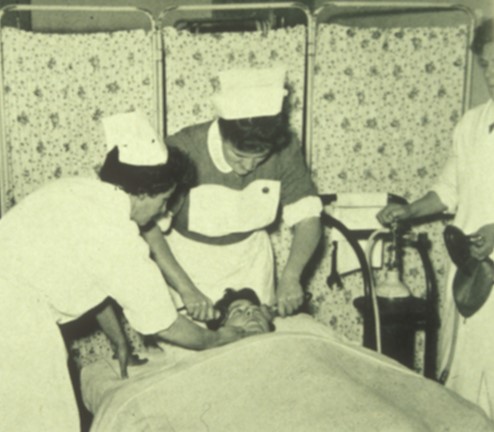
A patient being administered ECT as a form of inducing seizures
Henry Cotton believed that the reason why people became mentally ill was due to the fact that there had been previous infections in the body that had been left untreated. Due to this belief, he removed spleens, teeth, tonsils, and ovaries as a way of reducing their symptoms. He was not very successful and with all the procedures performed, the mortality rate was at 30-45%.
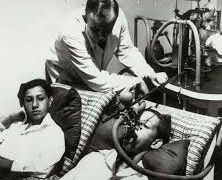
Dr. Henry Cotton performing one of his many procedures
Following World War II, attitudes towards mental health and awareness for these individuals shifted. World War II played a big part in support growing towards mental health patients. In 1946, the federal government signed the National Mental Health Act in which the government agreed to play a larger role in the mental health sector.
Following World War II, medications began to come about that seemed to alleviate many symptoms in which tended to benefit many of the men coming home. Thorazine was introduced as the first antipsychotic in the United States in 1954. In 1955, deinstitutionalization began with states such as New York implementing new laws known as the Community Mental Health Act. Acts such as the one in New York allowed for the mentally ill to live their life outside of institutions due to the fact that outpatient clinics were now being funded to give patients outpatient help as well as therapy.
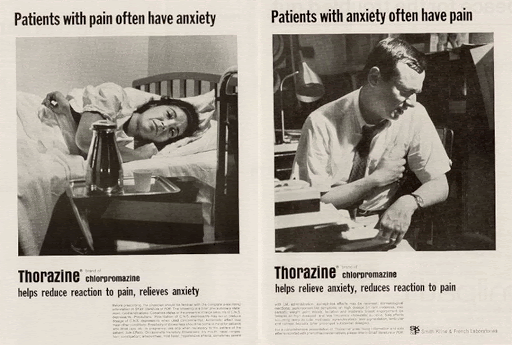
Advertisements for Thorazine in 1955
Following 1950s, patients lives began to improve. This was partly due to medications being introduced as a way of helping the patients symptoms. After patients were released, reformers hoped that they would integrate back into society peacefully and go back with their families. The sad truth is that many people did not have a family to turn back to due to the bad stigma surrounding the mentally ill, so they turned to government funding in order to be able to live. People tended to turn to half way homes, but these were, for obvious reasons, not the best living conditions.
The “revolving door” idea comes from the fact that medication is very expensive to obtain, and since most mentally ill patients were poor, they often found themselves having to get off their medication, have a psychotic break, be hospitalized, and then put back on their medication.
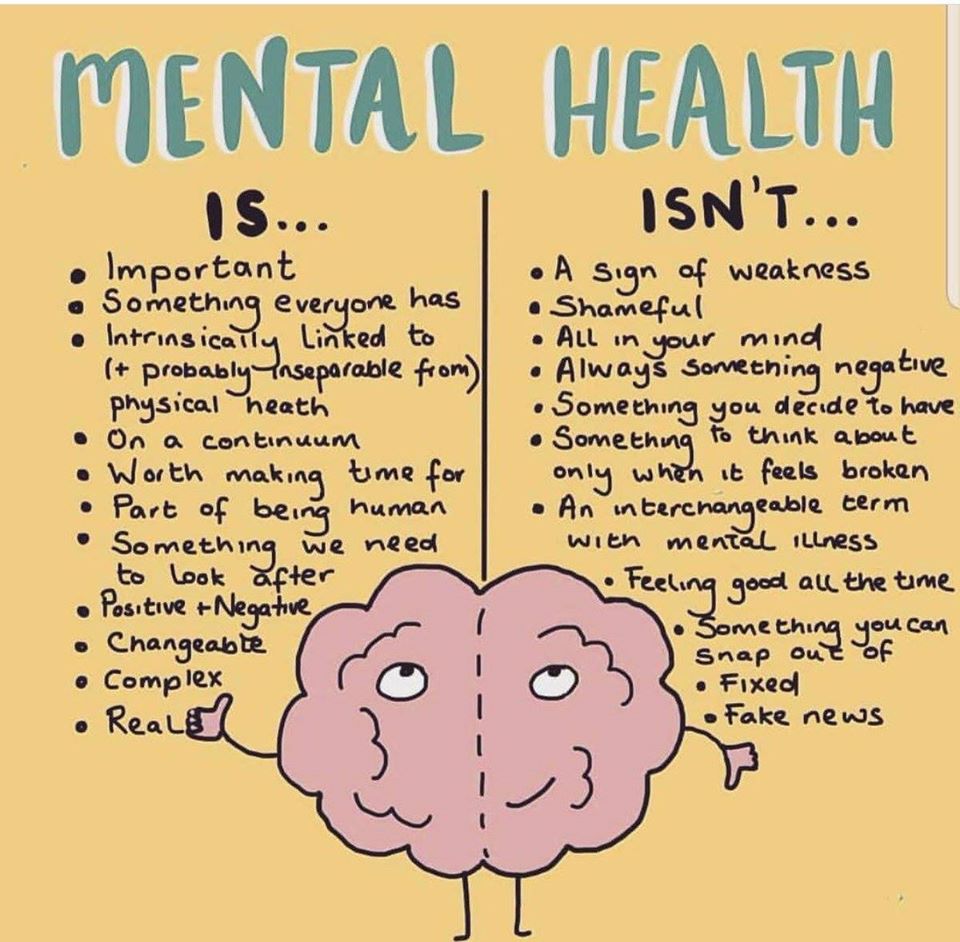
Today, mental health is still heavily negatively stigmatized. People in the United States do not see that improvements are necessary in order to make everyones lives safer in the country. A lot of the time people think that the mentally ill cannot and should not be helped, and rather than seeing their illness as a diseases, they solely think that these people are crazy. Change is needed.
The United Kingdom – a History
The level of help offered to psychiatric patients in the 18th and 19th century was very little to none due to the fact that it was believed that the problem was a physical one, not a psychological one.
Bethlem Royal Hospital (also known as Bedlam) is one of the oldest and most infamous mental asylum located in Southern London. It was the first ever place to focus on psychiatric care in Europe. It was built during the reign of Henry III and was originally going to be used as a way of supporting the Crusader Church and linking England to the Holy Land. Although this hospital eventually got used for the mentally ill, it was not until the 19th century that it really began to be infamous. The reason it became infamous was due to the fact that the hospital would allow regular people to come watch the mentally ill as a form of entertainment.
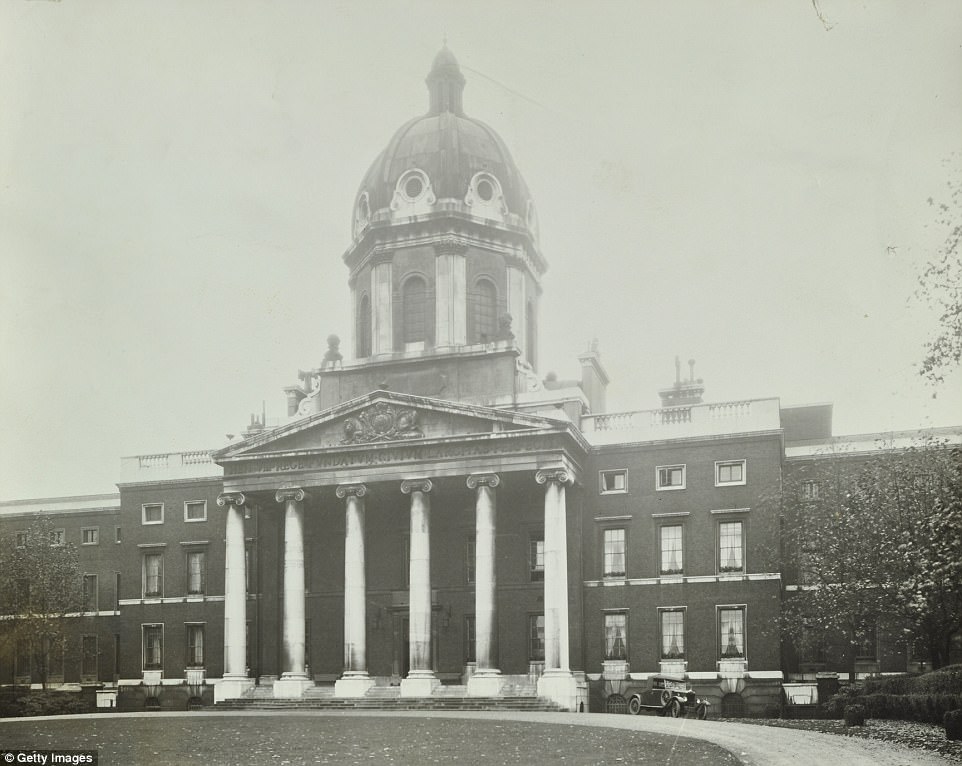
Beginning in the 17th century, private mental institutions began to become about more and more. According to sources in 1632, Bethlem Royal Hospital had “below stairs a parlor, a kitchen, two larders, a long entry throughout the house, and 21 rooms wherein the poor distracted people lie, and above the stairs eight rooms more for servants and the poor to lie in.” Going forward, most of the asylums were small in size, holding no more than 30 people and only about 7 asylums existed outside London.
In the 1800s, attitudes toward mental illness shifted to being an attitude of compassion rather than ridiculing those with a mental illness. This attitude shifted primarily due to the fact that people found out that Henry III had a mental illness and they believed that they had to do everything in their power to “cure” the mentally ill.
In 1808, the County Asylums Act was passed which allowed for magistrates to build partially state funded mental asylums across every county in England. This was due to mental institutions becoming public towards the beginning of the 19th century. Due to the County Asylums Act, the first public asylum to open was in Nottinghamshire in 1812. Following the opening of public institutions, Parliamentary Committees were created as a way of weaving out abusive treatments that were taking place at private institutions such as Bethlem. It was not until 1828 that this committee was really able to do anything, as they were finally able to license and supervise these private institutions, this allowed for mental health patients to finally stop being seen as something that needs to be taken care of and began to be seen as people who need help.
Due to the Act, a Lunacy Commission was created in which help make sure that certain rules and regulations were followed when it came to the patients in these institutions. For example, all institutions had to have a real licensed physician in each institution.
Mental asylums began to be built more rapidly, and were always built outside of the city in an attempt to keep the mentally ill away from society. They were built very nicely and with a specific sense of architecture. Inside the asylums, there were specific rooms known as “padded cells” which functioned as a way of calming down the patients. The rooms had padded walls and nothing sharp in them.

Enoch Powell was the Minister of Health in England. He began speaking about reform for the way the mentally ill was treated as early as the 1960s. In his Water Tower Speech (1961), Powell spoke about his intentions of deinstitutionalizing all mental asylums by the 1970s. His wish was not granted, and it was not until the 1980s and 1990s that mental asylums began to close down one by one. Therefore placing the mentally ill (who had been placed in these institutions for years, some as long as 30 years) back into society. This lead to some incidents in which the mentally ill got a negative stigma again.
The United Kingdom began to close down their asylums. With the most recent closure being in 2010, the Runwell Hospital. This shows that the United Kingdom is progressing towards attempting to integrate the mentally ill back into their society.

Australia – a History
Australia began using their mental institutions as a way of policing the mentally ill and making sure that they were punished. The punishment was a sort of imprisonment in order to make sure that the greater community was not “at risk”.
When convicts were taken to Australia in 1788, many of the 750 individuals were mentally ill. Due to the way Australia was being governed, there was no distinction between the mentally ill and true criminals. Criminals, the mentally ill, and lunatics were typically clumped together and placed in the Town Gaol at Parramatta. By 1811, a mental asylum was created in Castle Hill, New South Wales. It was staffed by strong men as a way of controlling the patients in case they got violent.
In 1838, the first purpose built mental health facility was built in Sydney, known as the Tarban Creek Asylum. In the 1800s a total of 13 asylums were built in New South Wales. In 1843, the Lunacy Act was introduced in Victoria and stated that it was the responsibility of the state to make sure that the mentally ill was properly taken care of and that there was an increased need for medical treatment.
In 1852, there was a government enquiry to begin looking into the violence taking place in the mental asylums towards the patients. Following the investigation done, doctors began to take leadership roles in place of the superintendents. It is because doctors took on the role of administration that the moral era began, meaning that patients were being treated with respect now rather than being seen as a problem.
Hospitals began to take on ideas of work in order to treat the mentally ill, they did this by providing the patients with farm work. Male patients were told to do the more physical work like farming and brickwork, while female patients were encouraged to do more menial jobs such as sewing and kitchen duties.

Following World War II, there was a change in the way the mentally ill would be treated. With the introduction of a bunch of new medication, patients were finally given hope that they would be able to leave the asylums because of being able to stabilize their emotions and symptoms.
In 1981, The Richmond Report published an article in which they advocated for the deinstitutionalization of mental asylums and promoted the integration of the mentally ill back into society. It was because of the idea of deinstitutionalization brought about by the Richmond Report that deinstitutionalization of patients began in 1992 but was poorly funded and orchestrated.

Sources:
A History of Mental Asylums. (n.d.). Retrieved from http://www.beyondthepoint.co.uk/property/a-history-of-mental-asylums/
America’s Long-Suffering Mental Health System: Origins: Current Events in Historical Perspective. (n.d.). Retrieved from https://origins.osu.edu/article/americas-long-suffering-mental-health-system/page/0/1
Vrklevski, L. P., Eljiz, K., & Greenfield, D. (2017). “The Evolution and Devolution of Mental Health Services in Australia.” Inquiries Journal, 9(10). Retrieved from http://www.inquiriesjournal.com/a?id=1654
 "Mental Asylums"